Starting a blog feels exciting at first – until confusion hits.
What should I do first?
Am I missing something important?
Is my blog ready to be published?
Most beginner guides discuss how to start a blog, but they often fail to provide a clear checklist. That’s why people keep jumping from one article to another.
This guide fixes that.
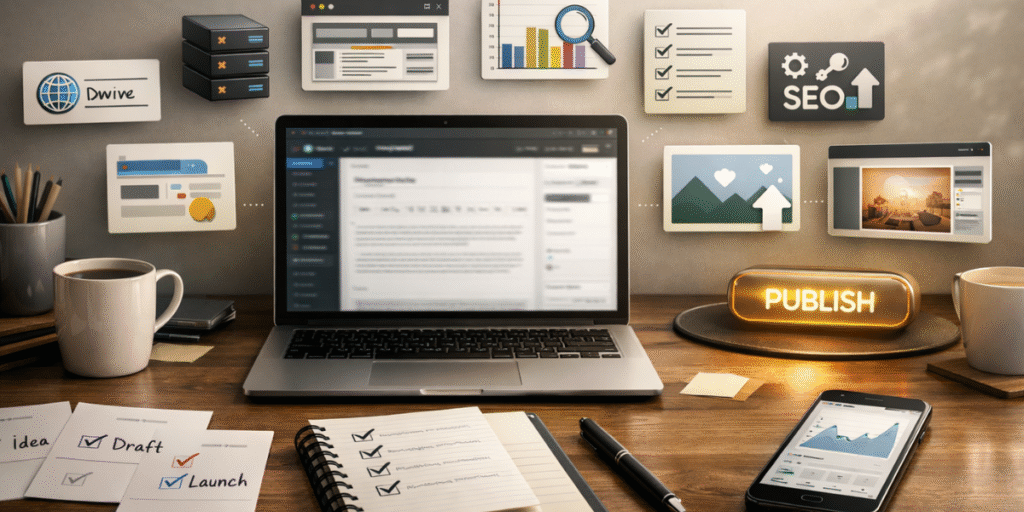
Below is a complete, step-by-step blogging checklist – from the moment you decide to start blogging to the point where you confidently hit the Publish button.
No fluff. No guessing. Just clarity.
Phase 1: Before You Start Blogging (Foundation Checklist)
Many beginners skip this phase – and regret it later.
✅ 1. Choose One Clear Blogging Goal
Before anything else, decide:
- Do you want traffic?
- Do you want money?
- Do you want authority?
Your goal decides:
- Content type
- Monetization method
- Keyword strategy
Without a goal, blogging feels directionless.
✅ 2. Pick a Focused Niche (Not Too Broad)
Avoid niches like:
- “Technology”
- “Lifestyle”
- “Make money online.”
Better examples:
- Blogging for beginners
- SEO for small websites
- WordPress tutorials
A focused niche = faster trust + faster ranking.
✅ 3. Check If People Are Actually Searching
Before committing:
- Search your topic on Google.
- Look at “People Also Ask”
- Check auto-suggestions
If people are searching, traffic is possible.
If not, even great content won’t help.
Also Read: How to Start Blogging for Beginners: A Simple Step-by-Step Guide
Phase 2: Blog Setup Checklist (Technical Basics)
You don’t need to be technical – just careful.
✅ 4. Choose the Right Blogging Platform
For beginners:
- WordPress.org = best for growth
- Blogger = okay for hobby blogs
If long-term growth is your goal, WordPress wins.
✅ 5. Buy a Simple, Clean Domain Name
Good domain rules:
- Easy to remember
- Easy to spell
- No numbers or hyphens
- Related to your niche
Your domain builds a first impression and trust.
✅ 6. Set Up Basic Pages (Often Missed)
Before publishing any blog post, make sure you have:
- About page
- Contact page
- Privacy Policy
- Disclaimer (if needed)
These pages are important for:
- Trust
- AdSense approval
- Professional appearance
Also Read: How to Choose a Domain Name for Blogging (Beginner Friendly)
Phase 3: Content Planning Checklist (Very Important)
This is where most beginners go wrong.
✅ 7. Do Basic Keyword Research
You don’t need advanced tools.
Start with:
- Google search suggestions
- “People Also Ask”
- Low-competition, long-tail keywords
Example:
Instead of “blogging.”
Use “blogging checklist for beginners.”
✅ 8. Understand Search Intent
Ask:
- Is the user looking for information?
- A step-by-step guide?
- A comparison?
- A solution?
Your content must match the intent, not just the keyword.
✅ 9. Create a Simple Content Structure
Before writing, decide:
- H1 (main topic)
- H2 (main sections)
- H3 (sub-points)
A clear structure helps:
- Readers understand better
- Google crawls better
Phase 4: Writing Checklist (Before You Hit Publish)
This phase decides whether users stay or leave.
✅ 10. Write for Humans First
Good beginner content is:
- Simple language
- Short paragraphs
- Clear examples
Avoid:
- Over-technical terms
- Long, boring blocks
If a beginner understands it easily, you’re doing it right.
✅ 11. Add Clear Formatting
Use:
- Bullet points
- Numbered lists
- Bold text for important points
Formatting keeps users engaged and improves readability.
✅ 12. Use Images (But Don’t Overdo It)
Best practice:
- 1 featured image
- 1–2 content images
Images help:
- Break text
- Improve engagement
- Support Google Discover
Phase 5: SEO & Publishing Checklist
Small things here make a big difference.
✅ 13. Optimize Meta Title & Description
Make sure:
- The title is clear and clickable.
- The description explains the benefit.
- No keyword stuffing
Good meta = better CTR.
✅ 14. Set a Clean URL (Permalink)
Best URLs are:
- Short
- Keyword-focused
- Easy to read
Avoid unnecessary words.
✅ 15. Internal Linking (Often Ignored)
Before publishing:
- Link to 1–2 related posts
- Or link to category pages
Internal links help:
- SEO
- User navigation
✅ 16. Proofread Once (Minimum)
Always check:
- Grammar
- Spelling
- Flow
Even small mistakes reduce trust.
Phase 6: Final Publish Checklist
Before clicking Publish, ask yourself:
✔ Does this post fully answer the search query?
✔ Will a beginner feel confident after reading this?
✔ Is there any major confusion left?
If answers are “yes” – publish confidently.
What Most Blogs Miss (Important Insight)
Most beginner guides:
❌ Explain steps separately
❌ Don’t connect them logically
❌ Leave users unsure
This checklist works because:
✔ It’s sequential
✔ It’s practical
✔ It’s beginner-tested
You don’t need perfection.
You need clarity and consistency.
Final Thoughts (Read This)
Blogging success doesn’t come from doing everything.
It comes from doing the right things in the right order.
If you follow this checklist honestly, you’ll avoid 90% of beginner mistakes – and that alone puts you ahead of most new bloggers.